From Spectrum Monitoring to Spectrum Intelligence
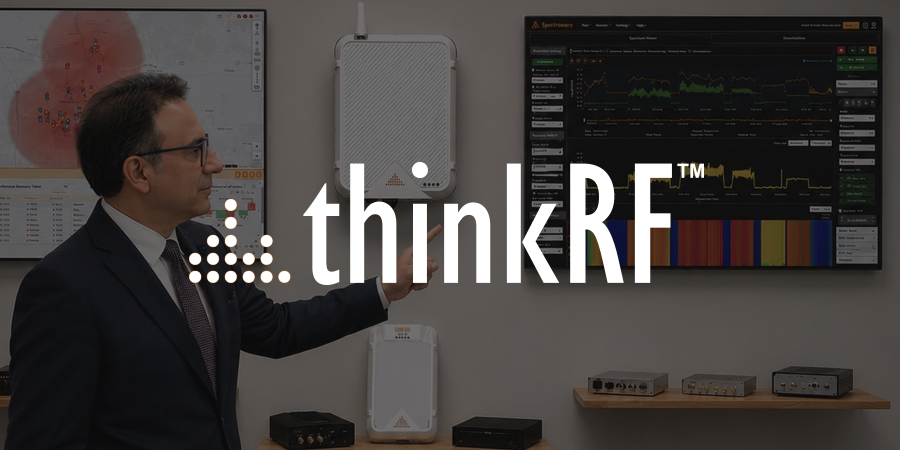
A Conversation with Tarek Helaly, President & CEO at thinkRF
Wireless communications underpin almost every aspect of modern life, from mobile networks and critical infrastructure to defence, aviation, satellite communications and public safety. Yet despite their importance, the radio frequencies that enable these systems remain largely invisible.
Ottawa-based thinkRF is working to change that. Under the leadership of President & CEO Tarek Helaly, the company is pioneering a new category it calls spectrum intelligence — combining autonomous sensor networks, AI-powered analytics and real-time spectrum awareness to help governments and enterprises better understand and manage increasingly complex RF environments.
We sat down with Tarek to discuss why spectrum intelligence matters, how thinkRF is transforming the industry, and where the company is headed next. Tarek brings more than three decades of experience in wireless technologies, signal processing and defence systems. Since joining thinkRF in 2013, he has led the company’s transformation from a respected RF instrumentation manufacturer into a global leader in AI-powered spectrum intelligence platforms.
Tarek, let’s start with the term you keep using, “spectrum intelligence.” What is it, and why does it matter?
Every country has agencies to watch its borders, its airspace, its cyber networks. Almost none can actually see its radio spectrum; and yet the spectrum is where the modern world lives. Drones, GPS, 5G, public safety communications, satellite links, etc. It all happens in a domain that is completely invisible to the human eye and, until recently, largely invisible to governments.
For decades the industry answer was “spectrum monitoring.” I’ve stopped using that term, deliberately. Monitoring tells you what’s happening. Intelligence tells you what it means and tells you in time to act. That distinction is not marketing. It’s the difference between a system that produces data and a system that produces decisions. We’re introducing spectrum intelligence as the new norm, and we believe that within this decade, no serious government will accept anything less.
That sounds like a bold claim. Isn’t “intelligence” just a rebrand of monitoring?
You cannot retrofit intelligence onto a spectrum analyzer. It’s an architectural difference, not a vocabulary change. A monitoring system tells you there was a signal at 3.5 GHz yesterday. An intelligence system tells you it’s an unauthorized uplink, that it’s the third occurrence this week, that it correlates with activity at two other sites forty kilometres apart, and it flags it while the signal is still on the air. Getting there requires four things working together: a network of sensors instead of standalone instruments, continuous data fusion across that network, AI/ML that can reason over time and space, and autonomous operation so the whole thing scales. That’s what we built SXM to be — from the ground up, not as an add-on.
Walk us through SXM. What makes it different from what came before?
Start with what the old world looks like: an engineer drives to a site with a spectrum analyzer, takes a snapshot, drives back, writes a report. It’s a rear-view mirror. By the time you understand what happened, the signal is gone, the interferer has moved, and the moment to act has passed.
SXM replaces that with a fabric of always-on sensors, covering a city, a border region, or an entire country, seeing the spectrum continuously, simultaneously, everywhere. And here’s the key insight: one sensor sees a signal; a network sees a pattern. When multiple time-synchronized sensors fuse their observations, you can geolocate a transmitter, track it as it moves, distinguish a licensed carrier from an intruder, and connect events across sites that would look completely unrelated in isolation. The intelligence doesn’t live in any single sensor. It lives in the fusion layer. That’s where a network becomes more than the sum of its nodes.
Where does AI fit in? Every company claims AI these days.
They do, and for our customers, that’s exactly the problem. A national regulator or a defence agency cannot put its name on a black box. So we built our AI around one governing principle: constrain the AI on facts, liberate it on judgment. Every final classification in our platform passes through deterministic gates. The AI is never allowed to invent evidence. But within those facts, it reasons: classifying signals automatically, detecting anomalies against learned baselines — “this band never behaves like this on a Tuesday” — correlating events, and generating finished intelligence reports a director can read, not just spectrograms an engineer has to decode.
That trust architecture is a genuine differentiator. In a market drowning in AI claims, we sell AI that a regulator can audit, defend, and act on.
Tell us about the sensor nodes themselves; Sentinel and the new SXMGO.
Think of them as two answers to the same question: how do you get persistent spectrum intelligence exactly where it’s needed?
Sentinel is our ruggedized workhorse, engineered to operate indoors and outdoors under genuinely harsh conditions, and I mean harsh in every direction. The same node has to survive the extreme cold of Canada’s north and the extreme heat of the Middle East and Africa; snow, rain, and dust. And it’s more versatile than people expect: many of our customers deploy Sentinels as the stationary backbone of a permanent 24/7 national network, while others mount them for mobile operations, maneuvering with the node on demand. Same unit, both modes.
SXMGO is the new generation — a miniature, portable, battery-powered node. It takes spectrum intelligence to places and moments a larger node can’t reach: a temporary event, an investigation, a site you need eyes on this afternoon.
Two things unify the family.
First, both deliver the same intelligence capabilities; they’re different form factors for different modes of operation, and customers mix them to match how they work.
Second, and this is a platform property, not a product feature, both are zero-configuration: you drop it, you walk away, and it works. No engineer on site, no manual tasking. And whichever nodes a customer deploys, the platform fuses them all into one picture.
Why does autonomy matter?
Autonomy is what makes national scale affordable. You cannot staff your way to 24/7 spectrum coverage of an entire country. No government has that many RF engineers. Whether it’s a Sentinel on a rooftop or an SXMGO in the field, the system decides what to look at, flags what matters, and escalates only what needs a human.
That flips the economics of the entire industry. A small team can now supervise an autonomous national network instead of an army of field engineers driving around with instruments. Intelligence output scales; headcount doesn’t.
Putting it all together – what actually changes for your customers?
Four things, concretely.
- Coverage: from spot-checks at a handful of sites to persistent, national awareness.
- Speed: from “investigate the complaint next week” to “alerted while the violation is on the air” because the value of knowing about interference at an airport or jamming near critical infrastructure decays by the minute.
- Confidence: enforcement decisions backed by fused, timestamped, auditable evidence from multiple sensors, not a single snapshot someone took on a Tuesday.
- And the deliverable itself: our clients don’t receive raw data, they receive finished intelligence: live maps, prioritized alerts, national intelligence reports. Their leadership reads our output, not just their engineers.
We’ve collapsed the loop from detection to understanding to action from weeks in the drive-test era down to minutes.
While the technology is reshaping how organizations understand spectrum, Tarek’s own experience has also shaped the direction of thinkRF.
Tarek, you’ve spent much of your career inside the kinds of organizations you now sell to. How has that influenced thinkRF?
I’ve worked in this field for more than thirty years, much of that time within large, complex organizations in the defence and telecommunications sectors – the same kinds of organizations we serve as customers today. That’s a rare vantage point, and I don’t take it lightly. I haven’t just studied what a spectrum operator, a regulator, or a defence user needs; I’ve sat in their seats. I’ve felt the frustration of a snapshot that arrives too late, of data nobody upstairs can read, of systems that need an expert babysitting them around the clock.
So when we designed SXM, we weren’t guessing at requirements. We were building the system I spent decades wishing I had. And my DNA is signal processing, not hardware, which is exactly why I knew not just what to build, but how: the value was never going to live in the box. It lives in the algorithms that turn signals into meaning. That’s why the platform produces finished intelligence instead of raw data, why it runs autonomously instead of demanding an engineer at every node, and why the AI is auditable instead of a black box. Every one of those decisions traces back to a real seat I sat in.
You’ve been with thinkRF since 2013, became VP Engineering in 2019, and took over as President in 2023. What changed when the engineer became CEO?
I like to say I’ve held three jobs at thinkRF: I built the technology, I led the people who build it, and now I lead the company that sells what it means.
Thirteen years inside this technology means I didn’t inherit a strategy deck, I inherited a conviction. thinkRF was a respected instruments maker with world-class RF engineering and a hardware mindset. We were being bought as instruments, when the real value was the intelligence those instruments could feed. The bet I made as President in 2023 was the one I’d been building toward as VP Engineering: the sensor is the beginning, not the product. Instruments, then platform, then intelligence.
What did that transformation look like?
We stopped selling boxes and started selling answers. We rebuilt the company around SXM – the networked sensors, the fusion layer, the AI, the autonomy – and rebuilt the brand around a category we named ourselves: spectrum intelligence. Revenue has tripled since. Margins are up. And the most telling change is who’s at the table: national regulators, defence, public safety. Those are conversations an instruments company never gets invited to.
What’s the advantage of leading that transformation from the inside?
Speed and belief. I didn’t need six months of discovery. I knew where every strength and every constraint lived, because I’d built half of them. And the hard part of any transformation isn’t the strategy; it’s belief. When the person asking the team to reinvent the company is the same person who spent a decade in the lab with them, “trust me, this works” carries different weight. I had a head start on belief.
How would you describe your leadership philosophy?
Results-driven accountability. Inside the company we call it “grit to greatness.” We’re a small Canadian company competing against global players, and we’re clear-eyed about what that means: we don’t out-spend anyone, we out-execute everyone. Every commitment has an owner and a date. And because I came up through engineering, there’s nowhere to hide behind me. I can read the spec, the algorithm, and the P&L.
How is the market responding? Where are you seeing the greatest momentum?
We have deployments on five continents, and I think that surprises people who assume an Ottawa-headquartered company sells mostly abroad or mostly at home. In fact, our largest deployment is right here in North America. Alongside that, national regulators have been among our fastest-moving adopters, including in the Middle East, where governments are leapfrogging the old drive-test model entirely and going straight to always-on national networks.
Our proudest proof point is expansion: when a client who has run our platform at national scale comes back and orders significantly more, that’s not a sale, that’s a verdict. We’re also seeing growing traction across public safety, correctional services, and the defence research community, and active discussions with allied government agencies in Canada and abroad.
Why is a Canadian company uniquely positioned to lead this category?
Timing and trust. The world is re-learning the word “sovereignty”. Allied governments want critical intelligence capabilities from companies inside their circle of trust, and Canada sits inside the closest intelligence alliance on earth. A Canadian platform for electromagnetic awareness is exactly what allies are looking for right now, and exactly what Canada should want to own domestically, and I’d note our largest deployment is Canadian, so this isn’t a capability we only export; it’s one we operate at scale at home. We’re built in Ottawa, we’re proud of it, and we think spectrum intelligence should be recognized as a sovereign Canadian capability — the same way we talk about sovereign cyber or sovereign space.
Where do you see thinkRF—and the spectrum intelligence industry—over the next five years?
Three directions.
- First, scale: taking SXM to more national deployments and deepening the autonomous footprint with SXMGO.
- Second, depth: pushing the intelligence layer from descriptive to predictive: not just “what does this mean,” but “what happens next”, anticipating interference and misuse patterns before they escalate.
- Third, breadth: spectrum intelligence fusing with other intelligence domains for defence and public safety, because electromagnetic awareness doesn’t live in isolation.
Every country watches its borders, its airspace, its networks. Almost none can see its spectrum. I think that ends this decade. Spectrum intelligence becomes the norm — as unthinkable to operate without as radar or cyber defence — and we intend to be the company the world sees it through.
As wireless technologies continue to evolve and the demand for resilient, intelligent communications grows, thinkRF is positioning itself at the forefront of a rapidly emerging category. By combining AI, autonomous sensing and decades of RF expertise, the company is helping governments and organizations move beyond simply monitoring the spectrum to understanding it — and acting on it in real-time.
Under Tarek’s leadership, that vision is becoming reality, positioning both thinkRF and Canadian innovation to play a leading role in the future of global spectrum intelligence.
Learn more about thinkRF’s Spectrum eXperience Management (SXM) platform and spectrum intelligence solutions at thinkRF.com

